
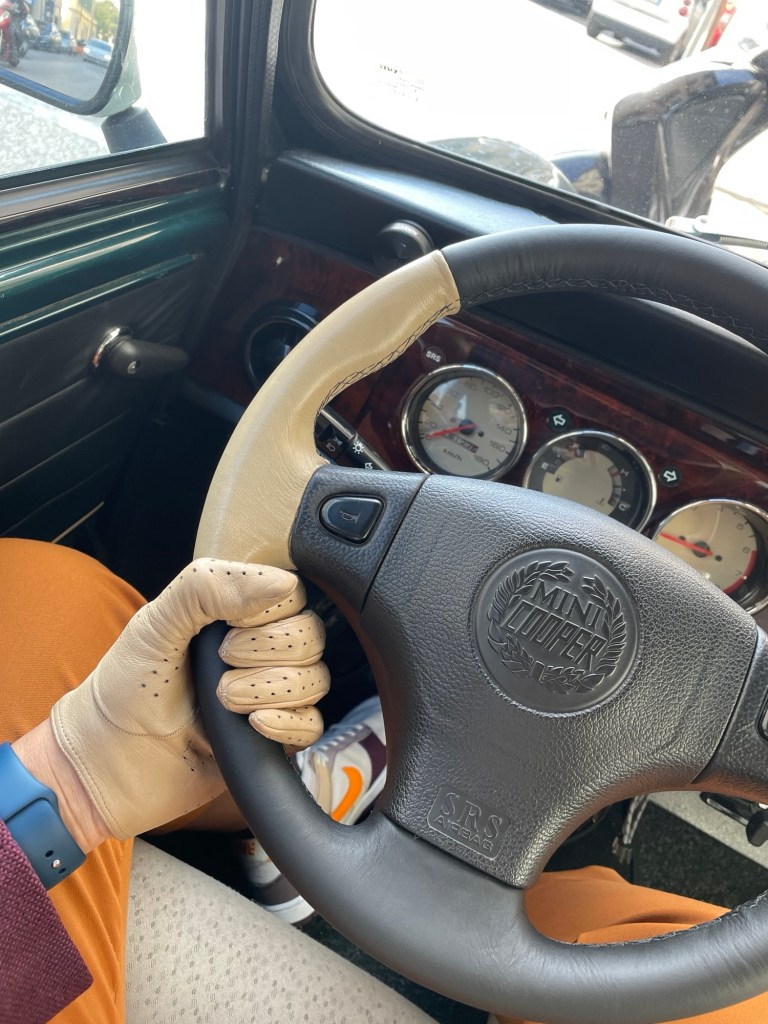
One thing about driving in Italy – it is every man person for themselves on the road! Rules and road signs are mere suggestions. There are only three lanes? Pshaw! There’s at least one more lane to be had. One way streets? Not a problem for motorinos, expect to have one zoom out the wrong way – after all, they are pulling out SO close to the street you’re on. Don’t even get me started on parking. That will be its own [short, yet titillating] article.
As hard as it is to acquire an Italian drivers license, it’s like the entire rulebook gets chucked out the window the moment you actually start driving. Even the driving school instructor tends to double park on a large and fairly busy road on the very day of the driving test. Totally normal.
Much like the advice I give anyone who wants to move here, my driving advice is this: “if you can accept that things will not work as they are supposed to and that anything can happen… you’ll be fine!” Driving here is like a continuous game of chicken, ya gotta have guts. This might sound like hyperbole, but as someone who has been driving in Italy since 2018 trust me, it’s not.
Another factor to consider is the constant construction. It sure takes a lot of it to keep those potholes right where they are. In most major Italian cities, there will consistently be some type of road construction happening, whether it’s general “maintenance” (yet the roads are consistently bumpy) or new construction for say, the tram, as is the situation here in Florence. Although I did say that road signs are a mere suggestion, it IS important to notice the ones announcing construction. It’s quite common for highly-trafficked, one-way streets to suddenly start going in the opposite direction.
I’ll leave you with three things to keep in mind that tend to lead to traffic fines. First, the infamous ZTL (Zona Traffico Limitato) – or Limited Traffic Zone. Most cities have these areas and are meant to protect the sacred downtown areas (il centro, the center). This is for the benefit of both tourists/visitors as it is for the actual residents of those areas. In Florence, at time of print, the hours are Monday to Friday 7:30 am – 8:00 pm, Saturdays 7:30 am – 4:00 pm and Sundays are free for all.
During the summertime these hours shift slightly, but the changes seem to be chosen at random. Here is a direct (Google Translated) quote from the Servizi alla Strada website: “From the first Thursday of April to the first Sunday of October (SUMMER NIGHT-TIME ZTL – the details of which are defined annually with a specific ordinance issued by the municipal administration)”
In order to avoid traffic fines, make sure you check before you turn onto an unknown street. There are signs, sometimes in helpful lightbox format: red for when the zone is active (don’t cross or you’ll get a ticket) and green for when it is inactive – a literal green light. Other times there are only white signs with the internationally known red circle meaning DO NOT CONTINUE. Checking the city maps before you start driving can be quite useful here.
The second thing that most often leads to traffic fines are the dreaded “preferential or reserved lanes” aka public transport lanes. These are mainly for buses, taxis and any other public vehicle and are meant to keep traffic flowing. Unfortunately these lanes sometimes pop up seemingly out of nowhere and are some of the few areas that have tele cameras ready to fine you for being on it for even a few seconds.
The final sign to keep an eye out for is the “autovelox” or speed camera signal. These tend to look like they have a little police helmet or officer and are oftentimes white but can be placed on orange, blue, or cement gray columns of sorts. The good thing about these speed traps is that the sign will be at least a few meters from the actual camera. So if you notice traffic suddenly slowing down significantly (say from 50 km/hr to 30 km/hr) but don’t see any traffic ahead, check for the forsaken Autovelox sign. You’re sure to catch a glimpse of one, hopefully in time to slow down along with the rest of the locals.
 Esmeralda's Road
Leave a comment